Here Is Why Your Guitar Picking Speed Isn’t Improving…
If you aren’t yet playing at the speed of at least 200 BPM in sixteenth notes (but really want to), then Mike Philippov’s latest article will greatly help you to get closer to this goal.


Sometimes the desire to fix every problem a student may have all at once may cause even more problems. Tom Hess describes how to break down a bad habit so that both teacher and student can tackle it in easy, manageable steps.
Have you ever thought about teaching but then thought that you might not be qualified? Let’s dispel a lot of the myths about what it takes to teach guitar.
In his latest article, Tom explores some of the problems that beginners tend to have making and changing guitar chords. Whether you’re a guitar teacher or just someone starting out on the guitar, you’ll find some very valuable tips here on how to go about practicing chord changes.
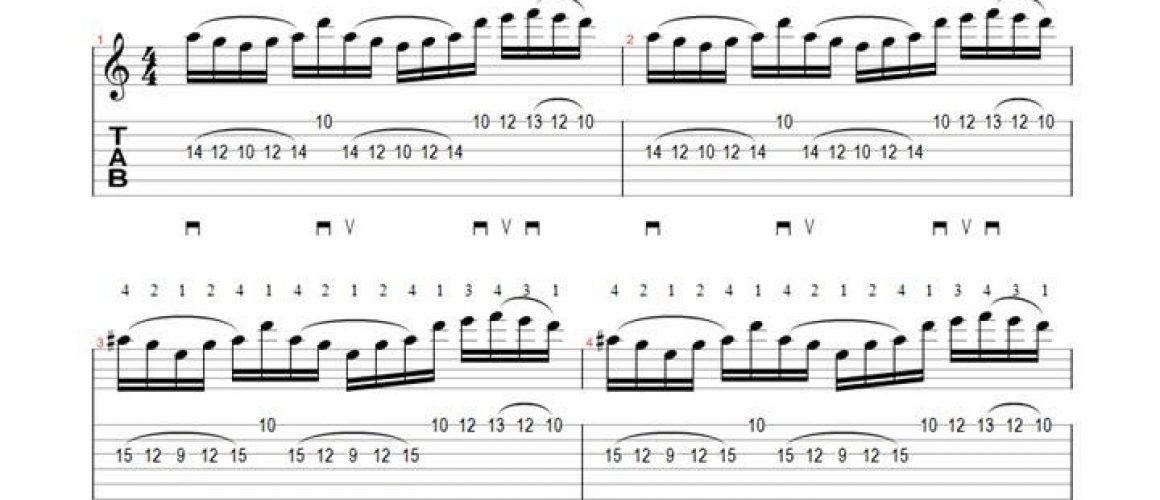
One way of developing speed, whether you’re a shredder or not, is to combine your picking and legato (slurring) techniques. Mike Phillipov lays out some step-by-step exercises to help you gain both speed and accuracy in your playing.
In the second article in this series, Tom examines the sloppines of extraneous string noise and demonstrates some excellent muting techniques that can benefit advanced players as well as beginners, giving them more control over their playing.
If you have read our lesson “Could You Teach Guitar?” and finished with a resounding “Yes!” then the next question is “How?” This article hopes to answer that question with a detailed look at how to teach the all-important first lesson.
Mike Philippov details five important steps to making memorable and interesting guitar solos. These are not only easy to follow, they also make a lot of sense!
Sloppy technique leads to sloppy playing and you can especially notice sloppy playing on the electric guitar! Tom Hess looks at the three basic problem areas and addresses two of them in depth in this first of two articles.
Sweep picking isn’t easy. But if you look at the pitfalls you’re likely to run into, that can go a long way toward making this technique work for you. Mike Philippov examines the aspects of sweep picking that most players stumble on and provides some very helpful practice techniques.
Teaching beginners is tricky at best and can be, for some guitar teachers, downright frustrating. Guitar teaching guru Tom Hess outlines five basic mistakes that many guitar teachers make when teaching beginner students and details way to avoid them in the first place.
It’s easy to know that you want a practice schedule. And it’s easier to abandon it fairly early in the game for all sorts of reasons, most of which are merely matters of perception. Tom Hess demonstrates that a highly efficient practice routine doesn’t have to be boring and can actually generate creativity. Having fun practicing usually leads to more practice and more practice leads to getting better faster.
Tom discusses the business side of teaching guitar, focusing on nine problem areas in promoting and maintaining your business as a guitar teacher.
Now here’s a list that anyone with the serious goal of playing professionally will want to have! Tom Hess goes through the main mistakes would-be professionals make when pursuing their dreams of being a player in the music industry.
This article discusses children and musical instruments. How young can one start? What things should be taken into consideration? There’s some wonderful tips and advice here.
The attitude with which you approach practicing can often affect just how effective your practicing is likely to be. Tom Hess explores these attitudes and gives some recommendations that will hopefully make your practice time both enjoyable and productive.
Speed, as a technique, can excite and enthrall an audience. Far from being emotionless, speed requires quite a bit of emotion and desire to achieve. Mike Philippov examines how to use a metronome to help you achieve results in speed-as-a-goal practice.
The attitude with which you approach practicing can often affect just how effective your practicing is likely to be. Tom Hess explores these attitudes and gives some recommendations that will hopefully make your practice time both enjoyable and productive.
Whenever you pick up guitar magazine or look through a book at a music store, do you ever think about the fact that someone actually wrote out all that TAB? Dale Turner, who’s written for Hal Leonard, Warner Brothers and many others, gives us a little insight into how to go about pursuing this kind of work as a career.